








Let us be honest — when most people hear the word cybersecurity, they think it is something only big companies or government agencies need to worry about. But that is simply not true anymore. Whether you are running a small business in Pune, managing a blog from home, or just doing online banking on your phone, cybersecurity touches your life every single day. And in 2026, ignoring it can cost you dearly.
In this guide, we will break everything down in plain and simple language — what cybersecurity actually means, why cybercrime has become such a massive problem, what parts of your digital setup are at risk, and what you can do to protect yourself and your business right now.
So, What Exactly is Cybersecurity?
Think of cybersecurity like the security system of your house — but for your digital life. Just like you lock your doors, install cameras, and maybe hire a watchman to protect your home, cybersecurity is all about protecting your computers, networks, data, and online systems from people who want to break in and cause harm.
But here is where many people get confused — cybersecurity is not just about protecting data. Yes, data protection is a big part of it. But it goes much further than that. A solid cybersecurity strategy also protects businesses from operational shutdowns, financial losses, legal trouble, and the kind of reputation damage that can take years to recover from.
Think about it this way — if a hacker gets into a hospital’s system and shuts it down, patients can lose their lives. If a cybercriminal breaks into a bank’s systems, thousands of customers can lose their savings overnight. That is how serious this has become. Cybersecurity is now as important to a business as its accounts department, its sales team, or its marketing — no exaggeration.
How Big is the Problem of Cybercrime in 2026?
You might be wondering — is this really that serious? The numbers will answer that for you, and honestly, they are quite shocking.
Cybercrime is now projected to cost the global economy $10.5 trillion every single year in 2026 — and that number is expected to climb to $15.63 trillion by 2029, according to Statista. To put that in perspective, if cybercrime were a country, it would have the third-largest economy in the entire world, sitting right behind the United States and China. That is bigger than the entire GDP of Japan, Germany, or India put together.
And it is not just the big corporations getting hit. Small and medium businesses, individual shop owners, freelancers, and everyday people are being targeted constantly. Here is a look at some of the most important numbers you need to know right now.
📊 Cybercrime in Numbers — 2026 Edition
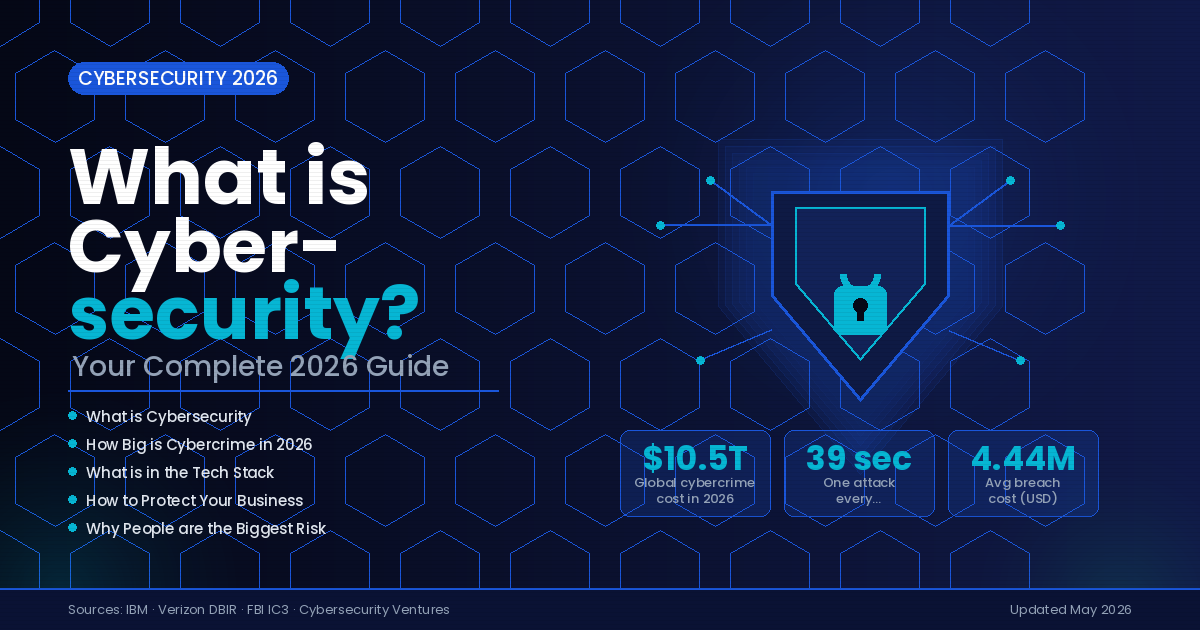
- Global cybercrime cost reaches $10.5 trillion annually in 2026 — Cybersecurity Ventures
- The average cost of a data breach worldwide is $4.44 million — IBM 2025 Report
- US cybercrime losses hit a record $20.87 billion in 2025 — FBI IC3 Report
- Organizations are attacked on average every 39 seconds — Verizon DBIR
- It takes companies an average of 277 days to identify and contain a breach
- 74% to 95% of all data breaches involve human error as the root cause
- Ransomware is involved in 44% of all breaches — up from 32% last year
- There are 4.8 million unfilled cybersecurity jobs worldwide right now — ISC2
The part about 277 days is what really gets you. Almost nine months pass before most companies even realise they have been breached. By that time, the attacker has already taken everything they wanted — customer data, financial records, passwords, business secrets — and is long gone.
cost in 2026
breach cost
every…
a breach
📈 Global Cybercrime Cost Growth (2015–2026)
Annual cost in USD trillions — showing how fast this problem has grown
Source: Cybersecurity Ventures
🔍 Root Causes of Data Breaches in 2026
What actually causes most security incidents around the world
Source: IBM, Verizon DBIR 2025
🎯 Most Targeted Industries (Breach Cost in USD M)
Industries paying the highest average cost per data breach in 2025
Source: IBM Cost of a Data Breach Report 2025
🦠 Top Cyberattack Types in 2026
Most common attack methods being used against businesses right now
Source: Verizon DBIR, FBI IC3 2025–2026
💰 Global Cybersecurity Spending vs Cybercrime Cost (2020–2026)
How much the world spends protecting itself vs how much cybercrime actually costs — the gap is growing
Source: Gartner, Cybersecurity Ventures, IBM 2026
What is the Tech Stack and Why Does it Matter for Cybersecurity?
Now here is a term that sounds technical but is actually quite simple once you understand it. Every business — whether a startup, a shop, or a large company — runs on something called a tech stack. This is basically the collection of all the software and systems that keep the business running.
Each piece of this stack can be a potential entry point for attackers. So when we talk about cybersecurity, we are really talking about protecting every single layer of this stack. Let us go through each one.
🖧 The Network
This is the backbone — the routers, switches, cables, Wi-Fi, and connected devices like computers, mobile phones, printers, and even smart gadgets (IoT devices). If someone unauthorised gets access to your network, they can move around freely and quietly — reading your emails, stealing files, and taking control of accounts without you even knowing.
💻 The Operating System
Whether you are using Windows, macOS, or Linux, your operating system is the foundation on which everything else runs. Hackers love to exploit security gaps in outdated operating systems. If you are not updating your system regularly, you are essentially leaving a window open for anyone to climb through.
⚙️ Core Services and Applications
These are the tools built on top of operating systems — things like Google Workspace, Microsoft 365, development platforms, and other software that employees use every day. Vulnerabilities in these can allow attackers to install programmes, modify data, or create new admin accounts without anyone noticing.
🗄️ Databases
This is the treasure chest — the place where all your valuable data lives. Customer information, financial records, order history, passwords — all of it sits in the database. This is what cybercriminals are after the most. Once they have database access, they can sell that data on the dark web, use it for blackmail, or commit identity fraud. In 2026, stolen data is as valuable as cash.
🌐 Web Servers and Websites
Your website runs on a web server, and if an attacker breaks through its defences, they can steal customer payment details, deface your website with their own messages, or redirect your visitors to fake phishing sites. For any business that operates online, this is a very real and very common threat.
🧩 Third-Party Plugins and Web Applications
This one is particularly tricky. Most websites use plugins and third-party tools — contact forms, payment gateways, booking systems, and so on. If an attacker finds a vulnerability in any of these tools, they can inject malicious code directly into your website. Your site could be spreading malware to your visitors without you even being aware of it.
Organizations face a cyberattack every 39 seconds on average. By the time you finish reading this sentence, someone somewhere has already been targeted.
Verizon Data Breach Investigations Report 2025
How Does Cybersecurity Actually Protect the Tech Stack?
Now that you understand what can go wrong, let us talk about how good cybersecurity practices protect each part of your stack. Think of these as different layers of armour.
🔒 Network Security
A VPN (Virtual Private Network) encrypts all the data travelling between your devices and your servers — so even if someone is watching the traffic, they cannot read it. It is like sending a letter in a locked box instead of an open envelope.
Network segmentation is another smart approach — dividing your network into separate sections so that if one part is compromised, the attacker cannot freely roam into everything else. Think of it as having separate rooms with separate locks in your office, rather than one big open space.
Phishing protection tools also sit at the network level, scanning incoming emails and links before they reach employees — blocking fraudulent messages that try to trick people into handing over credentials or clicking malicious links.
✅ Quick Action: Use a business VPN for all remote work, set up network segmentation between critical systems, and deploy an email security gateway to filter phishing attempts before they reach inboxes.
🛡️ Operating System Security
Running regular malware scans and vulnerability checks on your operating system is not optional anymore — it is basic hygiene. Outdated systems are low-hanging fruit for attackers. In 2026, with AI-powered hacking tools now being openly used by cybercriminals, an unpatched system can be identified and exploited within minutes of a vulnerability being made public.
✅ Quick Action: Enable automatic OS updates on all systems. Run a weekly malware scan using tools like Malwarebytes or your endpoint security suite. Remove any software that is no longer being used or supported.
🗄️ Database, Web Server and Application Security
For websites and online businesses, securing the database and web server is absolutely critical. Here are the main tools and techniques used for this layer of cybersecurity:
- Malware scanning and removal: Regular, automated scanning of your website files to catch and remove any injected malicious code before it can cause harm.
- Web Application Firewall (WAF): Acts like a bouncer at the door of your website — blocking suspicious visitors and malicious requests before they even reach your database.
- DDoS Protection: Shields your website from Distributed Denial of Service attacks — where attackers flood your site with traffic to crash it and take it offline.
- Regular Backups: If the worst happens and your site is compromised, a clean backup means you can restore everything quickly and get back online without starting from scratch.
✅ Quick Action: Install a WAF (Cloudflare is a good starting point for most websites), schedule automated daily backups stored in an offsite location, and run a site malware scan at least once a week.
Cybersecurity is Also About People — Not Just Technology
Here is the most important thing that most cybersecurity articles forget to mention: your biggest security risk is not a software bug or a network weakness. It is your own team.
As per multiple industry reports, 74% to 95% of all data breaches have human error as the root cause. Someone clicked a suspicious link in an email. Someone used the same password everywhere. Someone shared their login credentials over WhatsApp. These things happen in every organisation — from small startups to global enterprises.
This is why security awareness training is no longer a nice-to-have — it is a must. When your employees know what a phishing email looks like, when they understand why they should not use the same password for everything, and when they know the right steps to take if they think something is wrong, your entire organisation becomes far more secure.
It is also about building a culture. When the leadership of a company takes cybersecurity seriously, discusses it openly, and leads by example, that attitude filters down to every employee. A team that thinks security-first is your strongest line of defence.
⚠️ The Human Factor — Fast Facts
- 3.4 billion phishing emails are sent worldwide every single day
- Human error is the root cause in 74% to 95% of all security breaches
- Companies that conduct regular security training reduce breach risk by up to 70%
- Microsoft blocks over 600 million password attacks every day on its platforms alone
Final Thoughts — Cybersecurity is Not Optional Anymore
If there is one thing to take away from everything we have covered, it is this — cybersecurity in 2026 is not something you can afford to put off. The numbers make that very clear. $10.5 trillion in annual cybercrime costs. An attack every 39 seconds. 277 days to detect a breach. These are not scare tactics — they are real figures from real reports by IBM, the FBI, and Verizon.
The good news is that most attacks are preventable. Keeping software updated, using strong and unique passwords, enabling two-factor authentication, training your team, and having a proper backup in place — these basic steps already put you miles ahead of the majority of businesses that are still ignoring this issue.
Cybersecurity is not a one-time setup and forget. It is a habit, a culture, and an ongoing practice. The businesses that treat it that way are the ones that stay protected, stay trusted, and stay ahead.
Sources & Further Reading
- IBM — Cost of a Data Breach Report 2025
- Verizon — Data Breach Investigations Report (DBIR) 2025
- FBI IC3 — Internet Crime Report 2025 (Released April 2026)
- Cybersecurity Ventures — Cybercrime Cost Projections 2026
- Statista — Estimated Global Cybercrime Cost 2024–2029
- ORDR — Cybersecurity Statistics 2026 Report