








When it comes to WordPress security, no single step makes your site completely bulletproof — but the right combination of awareness and action gets you close. In this guide, we break down the most critical security threats targeting WordPress sites in 2026 and what you can do to stay protected.
Is WordPress Secure in 2026?
The first question most people ask is: is WordPress actually secure? The short answer is yes — but with important caveats.
WordPress powers around 42.5% of all websites globally as of 2026, making it the most widely used CMS by a significant margin. That enormous footprint is exactly why it is the number one target for attackers — not because WordPress is uniquely insecure, but because the economics of attacking it at scale are simply too attractive to ignore. Wordfence alone blocks over 55 million exploit attempts and more than 6.4 billion brute force attacks every single month across its network.
The good news is that WordPress core itself is remarkably solid. The core development team’s strict security review processes have kept core vulnerabilities consistently low — only two core vulnerabilities were found in all of 2025. The real problem lies in the plugin ecosystem.
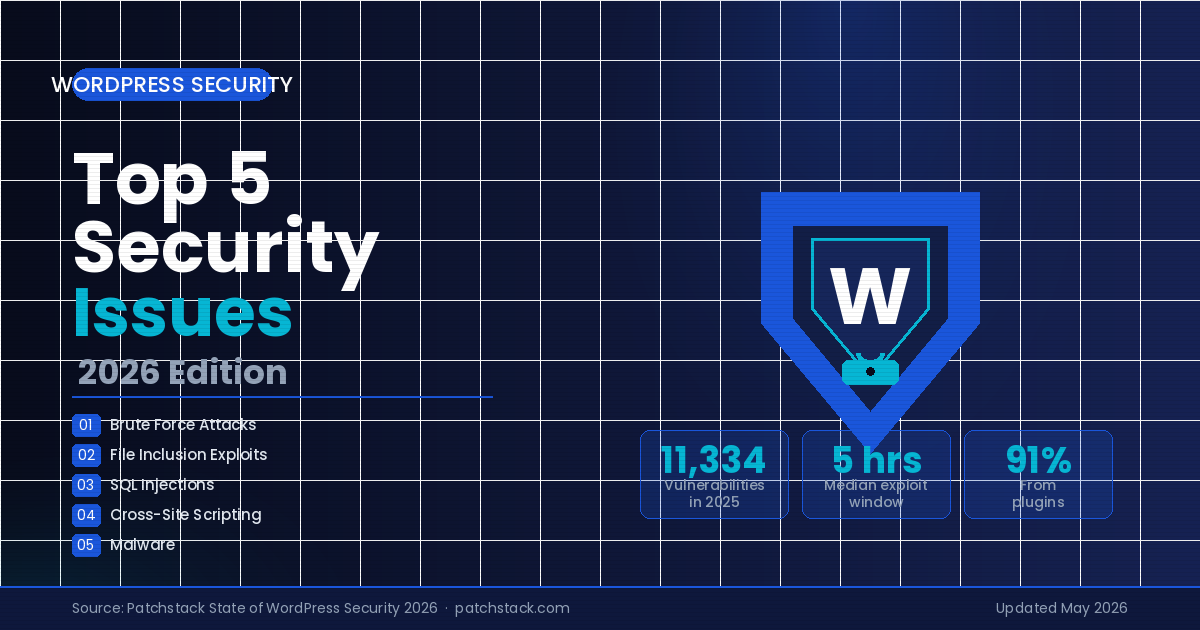
According to Patchstack’s State of WordPress Security in 2026 whitepaper, 11,334 new vulnerabilities were discovered across the WordPress ecosystem in 2025 — the highest number ever recorded, and a 42% jump from 2024. Plugins account for 91% of all vulnerabilities, while WordPress core accounts for just 6.
Perhaps the most alarming new development is the speed at which threats materialize. The weighted median time from vulnerability disclosure to first mass exploitation is now just five hours. That leaves almost no window for a manual response — proactive, automated security is no longer optional.
📊 2026 WordPress Security Snapshot — Source: Patchstack
- 11,334 new vulnerabilities recorded in 2025 — a 42% year-on-year increase
- 91% of vulnerabilities originate from plugins; only 6 from WordPress core
- Approximately 13,000 WordPress sites are hacked every single day (4.7 million annually)
- Median time from vulnerability disclosure to mass exploitation: just 5 hours
- 46% of vulnerabilities have no developer patch at the time of public disclosure
in 2025
increase
window
plugins
📈 Vulnerability Growth (2022–2025)
Total new vulnerabilities per year across the WordPress ecosystem
Source: Patchstack Annual Reports
🔍 Vulnerability Source Breakdown
Where the 11,334 vulnerabilities came from in 2025
Source: Patchstack 2026 Whitepaper
⚡ How Fast Are Vulnerabilities Exploited?
Cumulative % of vulnerabilities exploited after public disclosure
Source: Patchstack 2026 Whitepaper
🛡️ Top Vulnerability Types (2025)
Most common vulnerability categories found across WordPress plugins
Source: Colorlib / Patchstack 2026
🏠 How Well Do Hosting Defenses Block WordPress Attacks?
% of vulnerability-based exploits blocked by different hosting defense configurations (2025 pentest study)
Source: Patchstack 2026 Whitepaper — large-scale pentest of popular hosting providers
1. Brute Force Attacks
Brute force attacks remain one of the most relentless WordPress security threats. Attackers use automated bots to hammer your login page with thousands of username and password combinations until one sticks. Wordfence alone blocks over 6.4 billion brute force attempts per month — a figure that underscores just how constant and automated this threat has become.
The default /wp-login.php path is universally known, making it trivially easy for bots to find your login page. Enabling two-factor authentication (2FA), limiting login attempts, and changing your login URL are among the most effective countermeasures available today.

✅ Quick Fix: Install a security plugin like Wordfence or Solid Security, enable 2FA, and limit login attempts to 3–5 before a temporary lockout is triggered.
2. File Inclusion Exploits
File inclusion vulnerabilities occur when poorly written plugin or theme code allows an attacker to load remote or local files into your site’s execution environment. When successfully exploited, an attacker can gain access to critical files like wp-config.php — which contains your database credentials and security keys — essentially the master key to your entire WordPress installation.
Standard hosting defenses only block about 26% of vulnerability-based exploits, which means server-level protection alone is not enough. Regular code audits, keeping plugins updated, and using a Web Application Firewall (WAF) are essential layers of defense against file inclusion attacks.
✅ Quick Fix: Regularly check installed plugins regularly, remove unused ones, and add a WAF (Cloudflare or Patchstack) that operates at the application layer — not just the server level.
3. SQL Injections
SQL injection attacks target your WordPress database directly. By injecting malicious queries through vulnerable input fields or plugin code, attackers can read, modify, or delete your entire database — including user data, passwords, and content. They can also use SQL injection to insert hidden links to spam or malicious sites, silently poisoning your SEO and user trust.
A striking 43% of WordPress vulnerabilities can be exploited without any authentication at all, meaning an attacker does not even need a valid login to attempt a SQL injection through a vulnerable plugin. Using a WAF and ensuring all plugins are up to date significantly reduces this exposure.
✅ Quick Fix: Keep all plugins updated, use a WAF, and regularly back up your database. Consider a managed WordPress host that includes database-level monitoring.
4. Cross-Site Scripting (XSS)
Cross-Site Scripting (XSS) now dominates the WordPress security vulnerability landscape. XSS accounts for 47.7% of all WordPress vulnerabilities discovered, making it the single most common attack type. In an XSS attack, a malicious actor injects JavaScript into your pages that then executes in the browsers of your visitors — potentially stealing session cookies, redirecting users, or deploying further malware.
A concerning new driver of XSS vulnerabilities in 2026 is what Patchstack calls “vibe coding” — developers are using AI tools to generate plugin code and shipping it without fully auditing what the model wrote. When the person shipping the code cannot review it for security issues, vulnerabilities go live silently, and this trend is accelerating.
XSS accounts for 47.7% of all WordPress vulnerabilities — making it the single most common attack type discovered in 2026.
Patchstack — State of WordPress Security 2026
✅ Quick Fix: Only install plugins from trusted, actively maintained sources. Use a Content Security Policy (CSP) header and monitor your site with a vulnerability scanner like Patchstack.
5. Malware
Malware infections are typically the end result of one of the attack types above — once an attacker is in, they plant malicious code across your site’s files to maintain access, steal data, or serve harmful content to your visitors. Roughly 13,000 WordPress sites are hacked every day, or approximately 4.7 million annually.
What makes malware particularly dangerous in 2026 is how quickly attackers act. In the first week of January 2026 alone, 333 new vulnerabilities were disclosed — 120 of which had no patch available at the time of disclosure. Even diligent site owners keeping everything updated can still be briefly exposed.
The financial case for prevention is stark: the average recovery cost for a small business after a hack is around $14,500, compared to roughly $8 per month for proactive protection. Regular malware scanning, file integrity monitoring, and maintaining clean recent backups remain your most important tools for both detection and recovery.
✅ Quick Fix: Run weekly malware scans using Sucuri or Wordfence, set up automated daily backups via UpdraftPlus or Jetpack, and keep a clean offsite backup you can restore from at any time.
Final Thoughts on WordPress Security in 2026
The WordPress security landscape in 2026 is significantly more demanding than it was just a few years ago — more vulnerabilities, faster exploitation, and increasingly automated attacks. But the data offers one reassuring note: roughly 90% of attacks are preventable through basic security hygiene.
Keeping everything updated, using strong authentication, installing a reputable security plugin, and choosing quality hosting goes an extraordinarily long way toward keeping your site safe. Security is not a one-time task — it is an ongoing practice.