


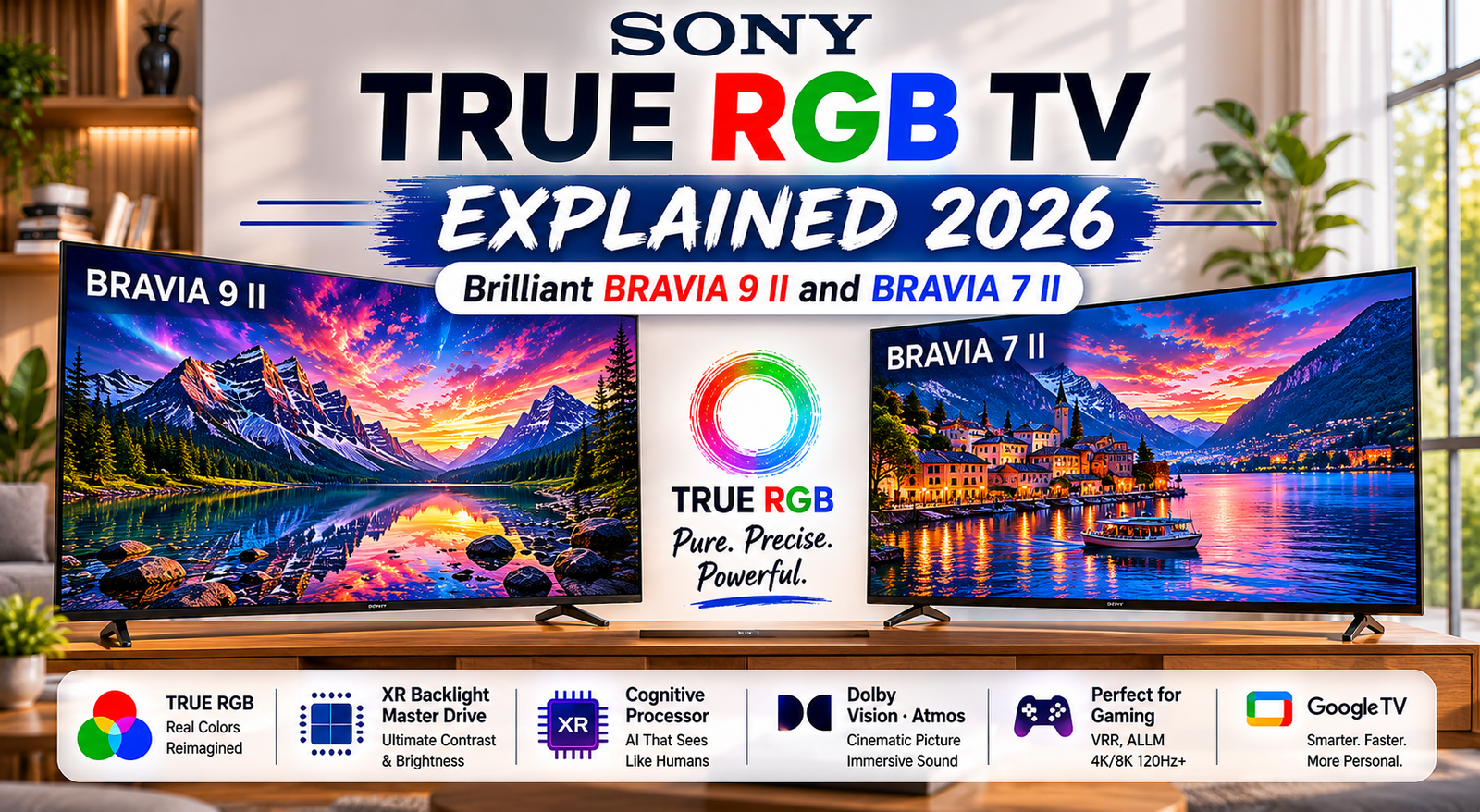

Sony True RGB TV just arrived and honestly I did not expect Sony to pull it off this way. May 27, 2026. BRAVIA 9 II and BRAVIA 7 II. And they are not Mini-LED TVs the way you are used to thinking about Mini-LED.
I want to explain what that actually means because most of the coverage I’ve read either goes way too deep into the engineering or skips the part that actually matters. I’ll keep this plain. I’ll tell you what it is, why it’s genuinely different, and whether you should care.
- True RGB is not a marketing rebrand of existing technology Sony’s True RGB uses independent red, green and blue LEDs – not white or blue LEDs filtered through layers. This is a real engineering difference that affects brightness, colour accuracy and viewing angles in ways conventional Mini-LED cannot match.
- BRAVIA 9 II hits 4000 nits – nearly double most Mini-LED TVs Most conventional Mini-LED tops out around 2000-2500 nits in real world testing. True RGB’s direct colour generation allows more brightness without energy loss from colour conversion.
- These are still LCD TVs – not MicroLED FlatpanelsHD confirmed this clearly. True RGB TVs are LCD panels with an advanced RGB backlight. Not self-emissive. Not MicroLED. This distinction matters if you are comparing to OLED.
- Only two HDMI 2.1 ports – the catch nobody wants to talk about Both BRAVIA 9 II and BRAVIA 7 II have only two HDMI 2.1 ports due to the existing chipset. No Dolby Vision 2 either. At a $3,599 starting price this is genuinely hard to defend.
What is a Sony True RGB TV and what does it actually mean?
Short version: Short version: A Sony True RGB TV forgets how normal LED TVs make colour. It throws that process out completely.
Normal LED TVs – even expensive Mini-LED ones – use blue or white light and then filter it into colours. Think of it like starting with white paint and mixing other colours into it. Every mixing step loses something. You never quite get back to the original purity.
True RGB skips the mixing. Red LEDs make red directly. Green LEDs make green directly. Blue LEDs make blue directly. No conversion layer. No phosphor film. No quantum dot filtering. The colour is born at the source.
That is genuinely the whole idea. And it matters more than it sounds because every layer of colour conversion in a conventional TV costs you brightness, colour accuracy and viewing angle performance. Remove the layers – get more of all three back.
Sony has been building toward this for over 20 years. The Qualia 005 in 2004 used an RGB light source. The Backlight Master Drive technology launched in 2016. True RGB in 2026 is the first time Sony has deployed this at proper consumer TV scale. It’s not rushed – it’s been a long time coming.
One thing I want to be clear about because I’ve seen confusion in comments online – True RGB TVs are not MicroLED. They are conventional LCD panels with an advanced backlight. The LCD layer is still there. FlatpanelsHD confirmed this explicitly. Important distinction when comparing to OLED.
The True RGB Sony True RGB implementation uses RGB Backlight Master Drive Pro with 22-bit control per colour channel – red, green and blue each get their own 22-bit driver. That’s 66-bit total backlight control per zone. Conventional Mini-LED runs on 10 or 12-bit drivers. The precision gap is significant.
Sony True RGB TV – BRAVIA 9 II and BRAVIA 7 II specs and prices?
Short version: BRAVIA 9 II is the flagship at $3,599 for 65 inches. BRAVIA 7 II starts at $1,599 for 50 inches. Both launched May 27, 2026 in the US and are available for pre-order now.
Let me go through each one.
BRAVIA 9 II – the flagship:
Up to 4,000 nits peak brightness. 99% DCI-P3 colour coverage. 90% BT.2020. Highest colour volume in Sony’s consumer TV history. Sizes from 65 inches up to 115 inches. The 75-inch prototype shown at IFA 2025 used 96,000 LEDs across 32,000 dimming zones – that’s four LEDs per zone in an RGB cluster. Audio array includes multiple speakers, specialised tweeters and a rear subwoofer.
Also includes RGB Triluminos Max and Luminance Booster Pro – Sony’s own technologies for maintaining colour accuracy when brightness is pushed high. That last part matters because most TVs show colour shifts at peak brightness. True RGB Sony True RGB is specifically designed to hold colour accuracy even at 4,000 nits.
The BRAVIA 9 II pricing runs from $3,599.99 for 65-inch all the way to $30,999.99 for the 115-inch version. Yes. Thirty thousand dollars. Moving on.
BRAVIA 7 II – the more sensible choice:
2,300 nits peak brightness. 88% BT.2020 coverage. 5,100 RGB Mini-LED elements across approximately 1,700 effective dimming zones. One LED per dimming zone rather than four on the BRAVIA 9 II – same technology, less density.
Sizes from 50 inches up to 98 inches. Google TV platform, 120Hz, VRR, ALLM, Dolby Vision all present. Starting at $1,599 for 50 inches. The 65-inch is $2,599. The 75-inch is $3,099.
Honestly? The BRAVIA 7 II is the one I’d actually point most buyers toward. Better price. Fewer reasons to feel short-changed. More on this in the recommendation section.
India pricing and availability not confirmed by Sony at time of writing – May 28, 2026.
How is the Sony True RGB TV different from Samsung Micro RGB?
Short version: Same core principle. Different engineering execution. Both launched in 2026. Neither has independent test results yet that clearly separate them.
Here’s what I find genuinely interesting about 2026 TV technology. Samsung called it Micro RGB. Sony called it True RGB. Hisense has their own RGB variant. LG is coming. They all arrived at the same fundamental idea at roughly the same time.
The core is identical across all of them – swap conventional blue or white LED backlight with independently controlled RGB LEDs. Generate colour at source rather than through conversion layers. Same idea. Different implementations.
Where they actually differ:
Samsung uses smaller LEDs in its Micro RGB TVs than Hisense – PCMag reported this specifically. Smaller LEDs mean more LEDs per panel and better backlight control per zone. Sony’s implementation uses 22-bit per channel control which is the highest precision LED driver published by any brand so far. Whether that translates to visible real-world superiority over Samsung’s implementation – genuinely unknown right now. Lab testing hasn’t concluded.
What I’d say is this: Samsung had a head start. Their R95H and R85H were out first. Sony is walking into a fight that has already started, as CECritic put it, which means they need True RGB Sony True RGB to actually deliver on the demo results in independent testing. That test data isn’t here yet. When it is – I’ll update this.
Sony True RGB TV vs OLED – which one wins?
Short version: Short version: Neither the Sony True RGB TV nor OLED wins outright. They win in different rooms.
I want to be straight here rather than pick a side just to give you a clean answer.
OLED still does some things that True RGB genuinely cannot match. When an OLED pixel goes black – it turns off completely. Zero light. True black. A 32,000 zone backlight on the BRAVIA 9 II is still not pixel-level control across 8.3 million pixels. The contrast ratio difference in a dark room is real and visible.
Blooming around bright objects on dark backgrounds is also still present on True RGB. Reduced compared to conventional Mini-LED – Sony’s demos showed real improvement. But not eliminated. OLED has no blooming because there’s nothing to bloom.
But here’s where True RGB hits back hard.
4,000 nits versus approximately 1,000-1,500 nits on most OLED panels. In a room with any significant light – windows, overhead lights, afternoon sun – that brightness gap is immediately visible. OLED washes out. True RGB stays vivid. That’s a practical daily living room advantage that matters for most buyers.
Colour volume is another real True RGB advantage. Sony claims four times the colour volume of a standard QLED. The direct colour generation at source means colour accuracy is maintained at peak brightness levels where conventional panels – including OLED – start to compromise.
Size is the sleeper advantage nobody talks about enough. OLED manufacturing above 97 inches is extremely difficult and expensive. The BRAVIA 9 II goes to 115 inches. True RGB will scale further. If you have a large room and want a genuinely large TV – OLED isn’t going to get you there at a sane price.
One more honest point from FlatpanelsHD who actually saw the panels side by side – the BRAVIA 9 II “looks very promising” but the BRAVIA 8 II QD-OLED “still outperforms it in some areas.” Keep that in your head when reading the launch day enthusiasm.
- True RGB is genuinely new technology – not a rebrand of existing Mini-LED
- 4000 nits peak brightness BRAVIA 9 II – nearly double most Mini-LED in real testing
- 99% DCI-P3 highest colour coverage in Sony consumer history
- Reduced blooming versus conventional Mini-LED – visible in demos
- Improved viewing angles – closing the gap with OLED meaningfully
- Zero burn-in risk – real advantage over OLED for channel surfers
- 66-bit backlight control per zone – highest precision published by any brand
- BRAVIA 7 II at $1599 for 50-inch is genuinely competitive True RGB entry price
- Only two HDMI 2.1 ports on both models – hard to defend at $3599
- No Dolby Vision 2 support – aging MediaTek Pentonic 1000 SoC chipset
- OLED still beats True RGB on black levels – pixel-level control not replicable by LCD
- Blooming reduced but not eliminated – still an LCD limitation
- India pricing and availability not confirmed May 2026
- Independent real-world lab testing not yet completed – demo results only
- $30,999 for 115-inch BRAVIA 9 II – mentioned for completeness not recommendation
Should I buy a Sony True RGB TV in 2026?
Short version: Short version: The Sony True RGB TV lineup gives you two choices – BRAVIA 7 II for most buyers, BRAVIA 9 II for the brightness chasers.
I spent a while going back and forth on this before landing here.
The BRAVIA 9 II is a genuinely impressive technology showcase. Everything about the picture quality direction is right. But $3,599 for a TV with two HDMI 2.1 ports and no Dolby Vision 2 in 2026 is a tough sell. Competitors at similar price points give you four HDMI 2.1 ports. Sony’s own reasoning – that the RGB LED development required the existing chipset – makes technical sense but doesn’t make the limitation disappear from the spec sheet. If you game and have a PS5 and a PC both wanting HDMI 2.1 – this TV wants you to pick one.
The BRAVIA 7 II is a different conversation. $1,599 for a 50-inch True RGB TV with 2,300 nits and Google TV. $2,599 for 65 inches. The two HDMI 2.1 limitation still exists here but it stings less at this price. This is Sony’s most interesting TV in years for a broad audience rather than just the premium tier.
My genuine recommendation – if True RGB is what you want, buy the BRAVIA 7 II and spend the saving on a soundbar. Better long-term choice for most people.
Technology Comparison – Final Summary
| Technology | Best For | Weakness | 2026 Example |
|---|---|---|---|
| Sony True RGB | Bright rooms, colour accuracy, large sizes | LCD limits – no pixel-level blacks | BRAVIA 9 II / BRAVIA 7 II |
| Samsung Micro RGB | Bright rooms, high LED density | Same fundamental LCD limitation | Samsung R95H / R85H |
| Conventional Mini-LED | Balance of brightness and value | More blooming, less colour purity | Hisense U8QG, LG QNED |
| OLED | Dark rooms, perfect blacks | Lower brightness, burn-in, size limit | LG C5, Samsung S90D |
| QD-OLED | Best OLED colour + better brightness | Still brightness limited vs RGB | Samsung S95D, Sony BRAVIA 8 II |
Is Sony True RGB the same as MicroLED?
No – completely different. True RGB is a conventional LCD TV with an advanced RGB LED backlight. MicroLED uses millions of self-emissive micro-scale LEDs as the actual display pixels with no LCD layer at all. FlatpanelsHD confirmed this distinction explicitly. True RGB is a backlight technology. MicroLED is an entirely different display architecture and currently costs well above $100,000 for consumer sizes.
Why does Sony BRAVIA 9 II only have two HDMI 2.1 ports in 2026?
Sony said this is because the RGB LED development process was built around the existing MediaTek Pentonic 1000 SoC chipset. Upgrading the chipset and deploying a new backlight technology simultaneously was not viable for this launch cycle. FlatpanelsHD called it a disappointment. It is. Sony has acknowledged it and future generations will address it.
Is True RGB better than OLED for PS5 gaming?
It depends what you value most. True RGB offers higher brightness and zero burn-in risk. OLED offers better response time and true black levels. The two HDMI 2.1 port limitation on current True RGB models is a real gaming problem if you have multiple devices. For competitive gaming in a dark room OLED is still preferred. For HDR gaming in a bright room True RGB has an argument.
When is Sony True RGB coming to India?
Sony launched BRAVIA 9 II and BRAVIA 7 II globally in May 2026 but has not confirmed India pricing or availability as of May 28, 2026. Business Standard reported Sony has not confirmed India launch timelines. Check Sony India official channels for announcement.
Is True RGB worth buying over a conventional Mini-LED TV in 2026?
For buyers who want the absolute leading edge – yes. The colour accuracy and brightness improvements are real. For buyers on a practical budget – conventional Mini-LED TVs like Hisense U8QG at $799 for 65 inches offer genuinely excellent performance at a fraction of the True RGB price. True RGB is a premium technology. It is not the only good choice in 2026.
The Sony True RGB TV is a genuine step forward in display technology. Whether the Sony True RGB TV is right for you comes down to your room and your budget.
Check the latest pricing and availability on Amazon – both BRAVIA 9 II and BRAVIA 7 II.
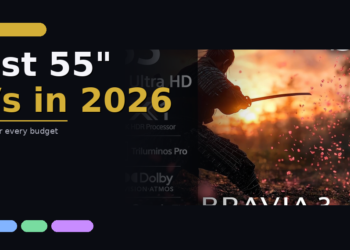
Also check my posts on Best 55inch Smart TVs in 2026 for more TV buying guidance.